

In the historic neighborhoods of Muskegon, Grand Haven, and Grand Rapids, charm is everywhere. From the sweeping Victorian porches to the intricate woodwork of mid-century bungalows, West Michigan’s architectural history is a point of pride. However, beneath those lath-and-plaster walls often hides a relic of the past that wasn’t designed for the 21st century: knob-and-tube (K&T) wiring.
At Belasco Electric, we’ve seen firsthand how the electrical demands of a modern West Michigan household. You need to run high-efficiency HVAC systems, EV chargers, and smart home hubs, which can push these vintage systems to their breaking point.
If you live in a home built before 1950, you have to understand that this isn’t just a matter of maintenance but safety and property value.
What Is Knob-and-Tube Wiring and Why Does It Matter in West Michigan?
Knob-and-tube wiring was the standardized method of electrical wiring in North America from about the 1880s through the 1940s. It consists of single-insulated copper conductors run through walls and ceilings. To keep the hot and neutral wires from touching wood or each other, they were supported by porcelain knobs and passed through porcelain tubes, where they went through joists or studs.
In West Michigan, where industrial growth in the early 20th century led to a massive housing boom, thousands of homes were outfitted with this system. While it was cutting-edge technology during the era of the first light bulbs, it lacks a critical component of modern safety, which is a grounding wire.
Key Facts About Knob-and-Tube Wiring
To understand the scope of the issue, we have to look at how electricity has changed over the last century.
- The Usage Period: Most common between 1880 and 1945. If your West Michigan home was built in this window, there is a high probability it has (or had) K&T.
- The Insulation: Unlike modern Romex (which uses plastic/PVC), K&T uses asphalt-saturated cotton cloth. Over 80 to 100 years, this cloth becomes brittle and flakes off, leaving bare wire exposed.
- Capacity: Original K&T systems were typically designed for 60-amp service. Today, the standard for a West Michigan home is 200 amps.
According to our estimate, nearly 25% of homes in older Midwestern urban centers still contain at least some active or abandoned knob-and-tube wiring.
Is Knob-and-Tube Wiring Dangerous? The Real Risks
Knob-and-tube is not inherently bad, but it is obsolete and prone to dangerous failure.
The National Fire Protection Association (NFPA) notes that electrical failures or malfunctions are a leading cause of home fires in the U.S. According to NFPA data, electrical distribution and lighting equipment accounted for an average of 32,000+ home fires per year recently, causing over $1 billion in direct property damage annually.
Why the Risk is Higher Today:
- Modifications: Over the decades, many homeowners spliced modern wires into old K&T. These improper connections are a primary fire hazard.
- Insulation Issues: K&T relies on air space to dissipate heat. When modern homeowners blow fiberglass or cellulose insulation into their walls to stay warm during Michigan winters, they damage the K&T wires. This causes heat to build up, which can ignite the insulation or the wooden studs.
- Insurance Realities: Many insurance providers in Michigan will refuse to issue a policy or will significantly raise premiums if a home has active knob-and-tube. They view it as an unquantifiable risk.
8 Signs It’s Time to Replace Knob-and-Tube Wiring in Your Home
If you suspect your home has K&T, look for these red flags. If you spot them, it’s time to call the professionals at Belasco Electric for a comprehensive inspection.
1. Two-Pronged Outlets
The most visible sign of an aging system is the absence of a third hole in your outlets. Modern electrical systems use a three-wire setup: a hot wire, a neutral wire, and a ground wire. The ground wire acts as a safety emergency exit for electricity. If there is a short circuit, the ground wire directs the surge safely into the earth.
K&T is a two-wire system with no ground. This means if a surge occurs, the excess electricity has nowhere to go but through your expensive electronics (like your 4K TV or laptop) or, worse, through you.
And using cheater plugs (three-to-two prong adapters) does not solve this. It only masks a serious safety deficit.
2. Flickering or Dimming Lights
If your lights pulse or dim when the AC kicks on or you start the microwave, it’s a sign of a voltage drop. K&T was designed for a world where a home’s biggest electrical draw was a few 60-watt light bulbs and a radio.
Today’s appliances (refrigerators, space heaters, and high-end gaming PCs) demand high inrush current. Because K&T wiring is often a smaller gauge than modern standards, and the circuits are frequently overloaded, the consumption of a large appliance starves the rest of the circuit, causing your lights to flicker. This constant fluctuation can eventually damage the motors in your appliances.
3. Brittle, Cracked, or Flaking Insulation
K&T wiring is insulated with rubber-impregnated cloth. Over 80+ years, the natural oils in the rubber dry out due to time and the heat generated by the wires. The result is insulation that becomes as brittle as a dry leaf.
In West Michigan attics, where temperatures fluctuate wildly between seasons, this decay is accelerated. If the insulation flakes off, you are left with bare copper wire hidden inside your walls. If two bare wires touch, or if a rodent chews on the exposed metal, an electrical arc can occur instantly, igniting nearby wood or dust.
4. Overheated Outlets or Switch Plates
Electricity should never generate noticeable heat at the point of use. If a switch plate or outlet feels warm to the touch, it indicates high resistance or arcing.
In K&T systems, connections were often made by wrapping wires together and soldering them. Over time, these solder joints can crack, or the wires can loosen. As electricity struggles to jump across these loose connections (arcing), it generates intense heat. If you see scorch marks or a slight browning of the plastic cover, the temperature behind that wall has already reached dangerous levels.
5. Frequent Blown Fuses or Tripped Breakers
Many K&T systems are still connected to original Edison-style fuse boxes. Fuses are designed to blow when too much current passes through them. It is a safety feature to prevent the wires from melting.
If you find yourself heading to the basement to replace fuses once a month, your system is telling you it’s overloaded. A common (and incredibly dangerous) mistake is over-fusing. For example, replacing a 15-amp fuse with a 20-amp or 30-amp fuse so it stops blowing. This allows the wires to carry more heat than they were designed for, effectively turning your wiring into a heating element inside your walls.
6. Evidence of Shadowing or Ghosting
Have you ever noticed dark, streaky stains on the ceiling around a light fixture or along the path of a wall stud? While this is sometimes caused by airflow and dust, in older homes, it can be a sign of thermal tracking.
Old wiring that is running too hot can create a static charge or a temperature differential that attracts household dust and soot to the wall surface. In more severe cases, these shadows are actually micro-deposits of smoke from wires that are smoldering behind the plaster.
7. Sagging or Loose Wires
In its prime, K&T was a masterpiece of tension; wires were pulled taut between porcelain knobs to ensure they stayed in the “open air” to cool down. However, as houses age over a century, those wires can sag.
If you look in your crawlspace or attic and see wires draped over joists or touching other pipes (like copper water lines or gas lines), the risk of a catastrophic short circuit increases exponentially. K&T requires a specific clearance to dissipate heat; when it sags and touches other materials, that heat is trapped.
8. Improper DIY Splices
Over the decades, various homeowners may have tried to “update” the home by splicing modern plastic-coated Romex into the old K&T. You can often spot these in the basement: look for black electrical tape wrapped around a junction where two different types of wire meet.
Because K&T is a single-conductor system (the hot and neutral wires are physically separated by inches or feet), splicing it into a modern “all-in-one” cable requires expert knowledge of load balancing. Improper splices are often loose and lack a junction box to contain sparks, making them the #1 point of failure in West Michigan electrical fires.
Safe DIY Ways to Check for Knob-and-Tube Wiring
As a homeowner, you can perform a visual audit safely, but never touch the wires.
- Check the Basement and Attic: Look at the floor joists (ceiling) in the basement. Do you see white ceramic knobs with wires wrapped around them?
- The Flashlight Test: Shine a light into the gaps where pipes or wires enter the floorboards. Look for the distinctive porcelain tubes.
- The Main Panel: Look at your electrical panel. If you see a mix of modern circuit breakers and old-fashioned screw-in fuses, there is a high probability of K&T remnants.
WARNING: NEVER pull on wires, open electrical boxes, or attempt to strip insulation to check for copper. K&T insulation is often made of materials that may contain low levels of asbestos or simply crumble upon touch, creating an immediate shock hazard.
Common Dangers of DIY Repairs on Knob-and-Tube Wiring
We understand the DIY spirit of people, but electrical work on K&T is one area where you must draw the line.
- The Grounding Myth: You cannot simply add a ground wire to a K&T circuit until you’re an electrician yourself. The entire architecture is different.
- Splicing Hazards: K&T is a large-loop system. Unlike modern Romex, the hot and neutral wires are often feet apart. Trying to tie these into a modern 3-wire system without expert knowledge creates imbalanced loads that can fry electronics.
- Insulation Danger: As mentioned, burying K&T in modern home insulation is one of the most common causes of house fires in older homes.
What Modern Electrical Upgrades Include (and Why They Matter)
Replacing your wiring removes all potential hazards and optimizes the circuit entirely. A full-service upgrade from Belasco Electric provides:
- True Grounding: Protects your expensive electronics (TVs, computers) from power surges.
- Increased Capacity: We typically upgrade homes to 200-amp service, allowing you to run central air, electric ovens, and car chargers simultaneously.
- AFCI/GFCI Protection: Modern Arc-Fault Circuit Interrupters (AFCI) detect dangerous sparking before a fire starts, while Ground-Fault Circuit Interrupters (GFCI) prevent shocks in kitchens and baths.
- Smart Home Readiness: Stable, modern power is required for the sensitive sensors used in smart thermostats and security systems.
The Knob-and-Tube Replacement Process in West Michigan
When you hire Belasco Electric, we follow a structured, safety-first process:
- Comprehensive Inspection: We map out exactly where the K&T is active vs. abandoned.
- Strategic Access: We aim to minimize damage to your historic plaster walls by using fishing techniques to pull new wire through existing cavities.
- Circuit Redesign: We don’t just replace wire; we modernize the layout, adding outlets where you actually need them.
- Panel Upgrade: We replace the old fuse box or undersized panel with a modern, labeled breaker system.
- Permitting and Inspection: We handle all West Michigan municipal permits to ensure the work is 100% up to code and IBEW/NECA standards.
How Much Does It Cost to Replace Knob-and-Tube Wiring in West Michigan?
Total replacement is a significant investment, but it pays for itself in safety and home value.
- Price Range: For a standard 1,500–2,000 sq. ft. home in West Michigan, costs typically range from $8,000 to $15,000, depending on accessibility (crawlspaces vs. finished basements).
- Factors Affecting Price: The number of stories, the type of wall material (plaster is harder to work with than drywall), and the current state of your electrical panel.
- Return on Investment (ROI): Beyond the peace of mind, a rewired home is much easier to sell. Most buyers will demand a K&T credit or replacement before closing. Additionally, your home insurance premiums may drop by 10% to 20% once the system is modernized.
Frequently Asked Questions About Knob-and-Tube Wiring
Q: Can I just replace the visible K&T in my basement?
A: No. Replacing just the visible portions leaves the most dangerous sections (those inside the walls and covered by insulation) active and hazardous.
Q: Will I have to tear down all my plaster walls?
A: Not with Belasco Electric. We use specialized tools to fish wires through walls, keeping holes to a minimum.
Q: Is abandoned knob-and-tube a problem?
A: If it is truly disconnected from the power source, it is harmless. However, we often find abandoned wires that are still live because of past sloppy renovations.
Protect Your West Michigan Home – Next Steps
Don’t wait for a flickering light to become a fire department call. Whether you are buying a historic home in Muskegon or have lived in your family estate for decades, a professional inspection is the first step toward safety.
At Belasco Electric, we bring decades of experience and a commitment to the highest industry standards. We serve construction managers, property owners, and families across West Michigan with integrity.
Contact us online to schedule your comprehensive electrical safety inspection.
Prefer to talk it through directly? Call 231-722-3997.
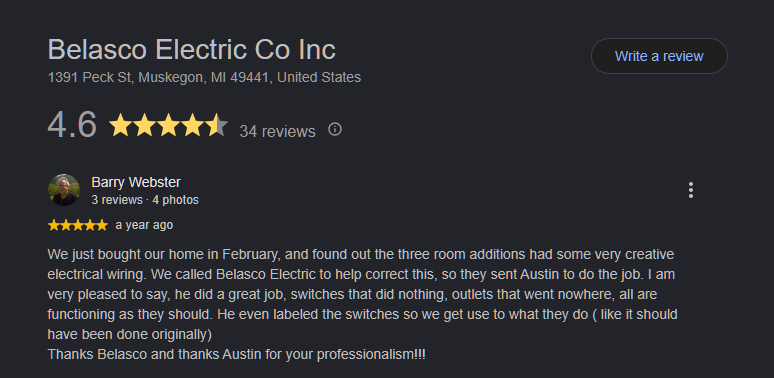
Curious what full-service residential electrical work looks like? Browse our residential electrical services or read what other West Michigan homeowners have to say in our testimonials.
Good to Read
Grand Rapids Electrician Shares 8 Energy Saving Tips for West Michigan Homes
Kohler Emergency Generators: Why They’re a 2026 Home Power Trend
Top-Rated Fire Alarm Services in West Michigan
Disclaimer:
All content on this blog is for general informational and educational purposes only and is provided “as is” without warranty. It does not constitute financial, legal, tax, investment, or any other professional advice.
The author and website owner disclaim all liability for any loss or damage arising from its use. Readers should conduct their own research and consult qualified professionals before making any decisions.


